Maintenance notifications, part 2: validation and an error contract
SAP PM case MIX-003 evolves with input validation, flat JSON GET responses and 400, 404, 502 and 500 errors with correlationId, without Groovy. Includes the v2 PDF manual.
Creating a maintenance notification is only part of the integration. The technician's application also needs to know whether equipment was empty, the requested notification does not exist or SAP is unavailable.
In MIX-003 part 1, we connected an API to SAP S/4HANA and Plant Maintenance (PM) through API Management, Cloud Integration and Cloud Connector. Part 2 develops Variant B, Block 1: validate inputs, transform query output to JSON and return recognizable error responses using standard steps without Groovy.
Status on September 24, 2026: the updated laboratory README and evidence mark Block 1 closed. GET XPath expressions and equipment mapping were corrected. The re-test created notification 10000960 and retrieved it as flat JSON with 15 fields. Additional APIM governance and externalization blocks remain pending.
Download the part 2 manual — English v2, 12-page PDF
The PDF includes design, configuration screenshots, Bruno tests and build errors. It is also available in Resources.
What changes from part 1
| Situation | Documented Block 1 result |
|---|---|
| Valid POST | 201 with notification number and equipment without leading zeros |
| GET for an existing notification | 200 with flat 15-field JSON |
| Out-of-range priority or empty equipment | 400 INVALID_REQUEST, before calling SAP |
| Valid number of a nonexistent notification | 404 NOTIFICATION_NOT_FOUND |
| Well-formed equipment rejected by SAP | 400 BACKEND_REJECTED |
| Cloud Connector disconnected during the test | 502 BACKEND_UNAVAILABLE |
| Malformed JSON | 500 INTERNAL_ERROR; changing this to 400 remains an improvement |
The common error contract has three fields: code, message and correlationId. This block uses the MPL identifier for correlation. Consumer-provided X-Correlation-ID belongs to a later stage.
The iFlow and its new routes
The artifact remains Manage_MaintNotification_Postman_to_S4HANA. It retains create and query branches, adding validation, existence checks and a shared Exception Subprocess.
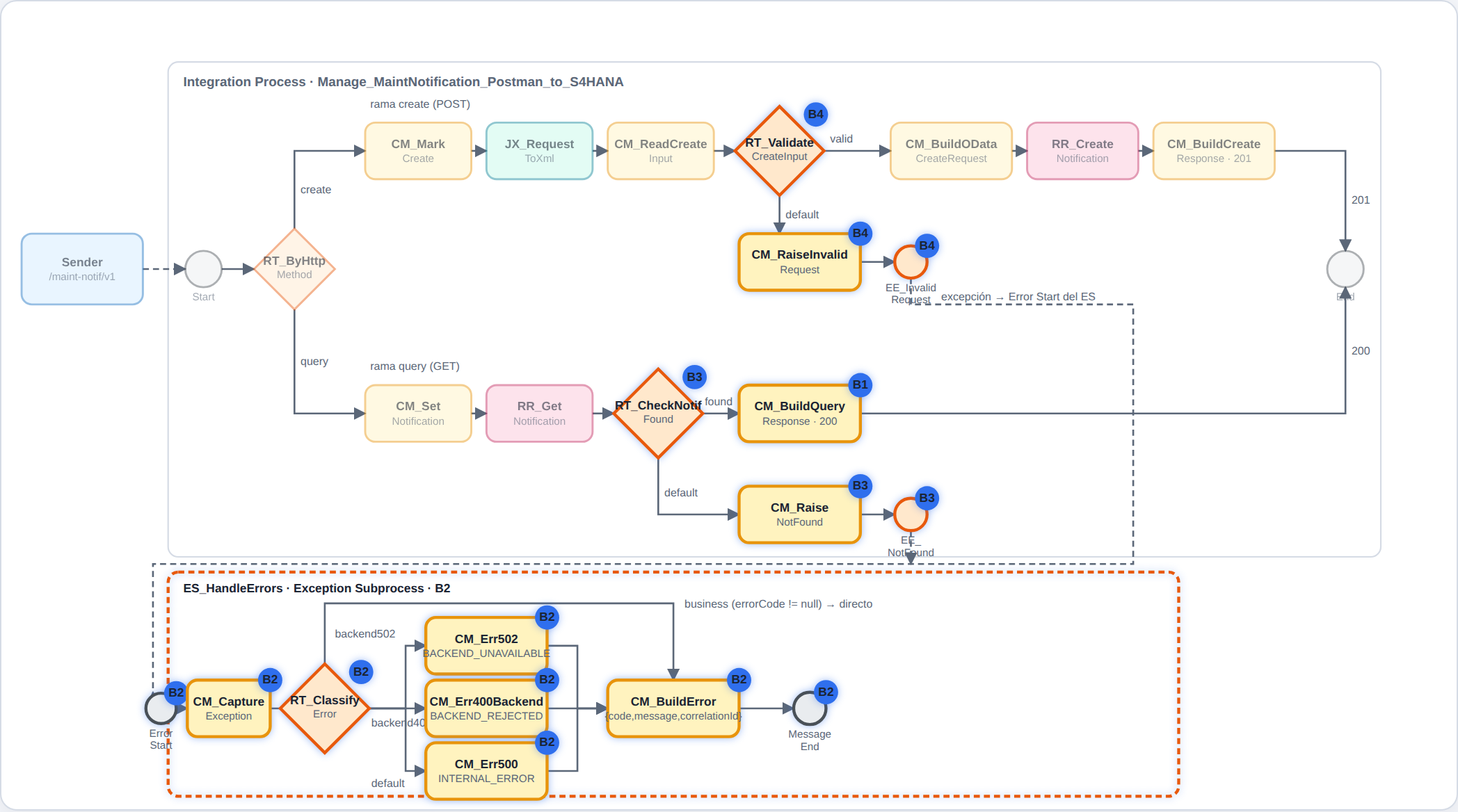 Highlighted steps represent the case evolution. Click the image to enlarge the diagram.
Validate POST before the receiver
After JSON to XML conversion and property extraction, RT_ValidateCreateInput evaluates a Non-XML condition. The exercise rules are:
| Field | Laboratory rule |
|---|---|
| Notification type | M1, M2 or M3 |
| Priority | A value from 1 to 4 |
| Equipment | 1–18 digits |
| Description | 1–40 characters |
| Reporter | Up to 12 alphanumeric or underscore characters; this block's expression allows empty input |
These rules reflect the exercise contract, not every possible SAP PM contract. S/4HANA still determines whether equipment exists: a numeric string can pass validation and be rejected by the backend.
Invalid input sends the flow through CM_RaiseInvalidRequest, which sets errorStatus, errorCode and errorMessage. An Error End Event then triggers the Exception Subprocess. The invalid-priority and empty-equipment tests show no receiver call.
Validation happens after JSON to XML conversion. Syntactically invalid JSON therefore fails before the Router and returns 500 INTERNAL_ERROR in the tested version.
Distinguish a nonexistent notification
The OData query uses $filter. Empty results can arrive with HTTP 200, so the receiver's status alone cannot establish that the document exists.
RT_CheckNotificationFound checks response records with an XML condition using count(). The default route uses CM_RaiseNotFound, sets 404 and NOTIFICATION_NOT_FOUND, then throws an Error End Event.
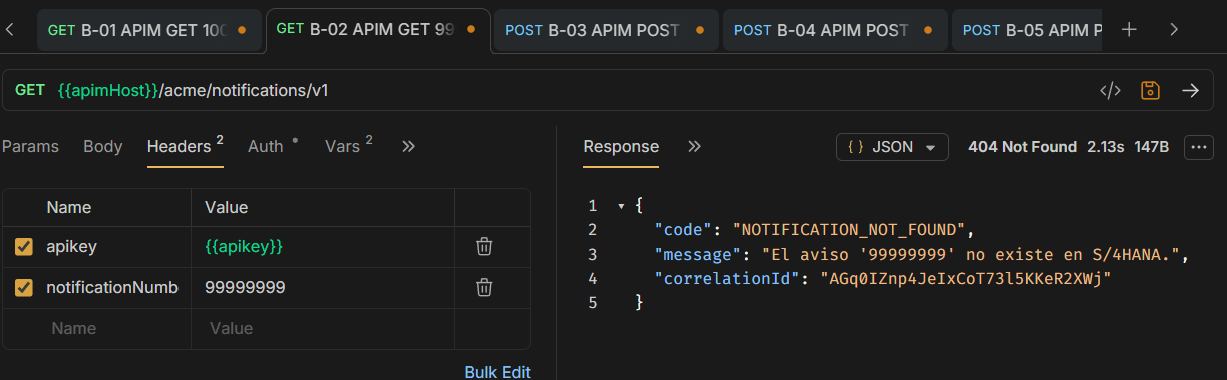 B-02: test number 99999999 does not exist in the laboratory. The error contract passes through APIM.
A malformed number is a different scenario. During the build, a 14-digit number caused the backend to reject the filter with 400. That test does not demonstrate the 404 behavior.
A common error contract
ES_HandleErrors catches Integration Process exceptions. CM_CaptureException copies ${exception.message} to property exMsg, and RT_ClassifyError selects a response:
- Already defined business error: retain the validation 400 or not-found 404 properties.
- Recognized connectivity failure: return
502 BACKEND_UNAVAILABLE. - Recognized backend 400 rejection: return
400 BACKEND_REJECTED. - Other exceptions: return
500 INTERNAL_ERROR.
This block's technical classification searches exception-message keywords. It is the implementation tested in this laboratory; it does not guarantee classification of every adapter error.
In CM_BuildError, set header CamelHttpResponseCode with Type = Expression and value ${property.errorStatus}. Also set Content-Type: application/json. Contract example, retaining the tested message's original language:
{
  "code": "NOTIFICATION_NOT_FOUND",
  "message": "El aviso solicitado no existe en S/4HANA.",
  "correlationId": "<MPL_ID>"
}
The message means that the requested notification does not exist in S/4HANA. Record the code in SAP_MessageProcessingLogCustomStatus to find messages by outcome. The subprocess ends with Message End, returning the constructed response to the consumer.
The backend-rejection test returned technical text Bad Request : 400. Extracting the OData error's business detail is an additional refinement; that text alone does not explain why SAP rejected the equipment.
Flat JSON GET: the re-test that closed the block
The first CM_BuildQueryResponse attempt returned 200 but concatenated document values into maintenanceNotification. The XPath properties contained only field names: MaintenanceNotification matched the root, whose text value included its entire content.
The documented correction uses each property's complete path against the observed receiver XML:
/MaintenanceNotification/MaintenanceNotificationType/MaintenanceNotification
/MaintenanceNotification/MaintenanceNotificationType/NotificationType
/MaintenanceNotification/MaintenanceNotificationType/NotificationText
On September 24, those paths and the create response's TechnicalObjectLabel adjustment were applied. POST returned equipment = "10000"; GET for the new notification returned the expected 15 fields.
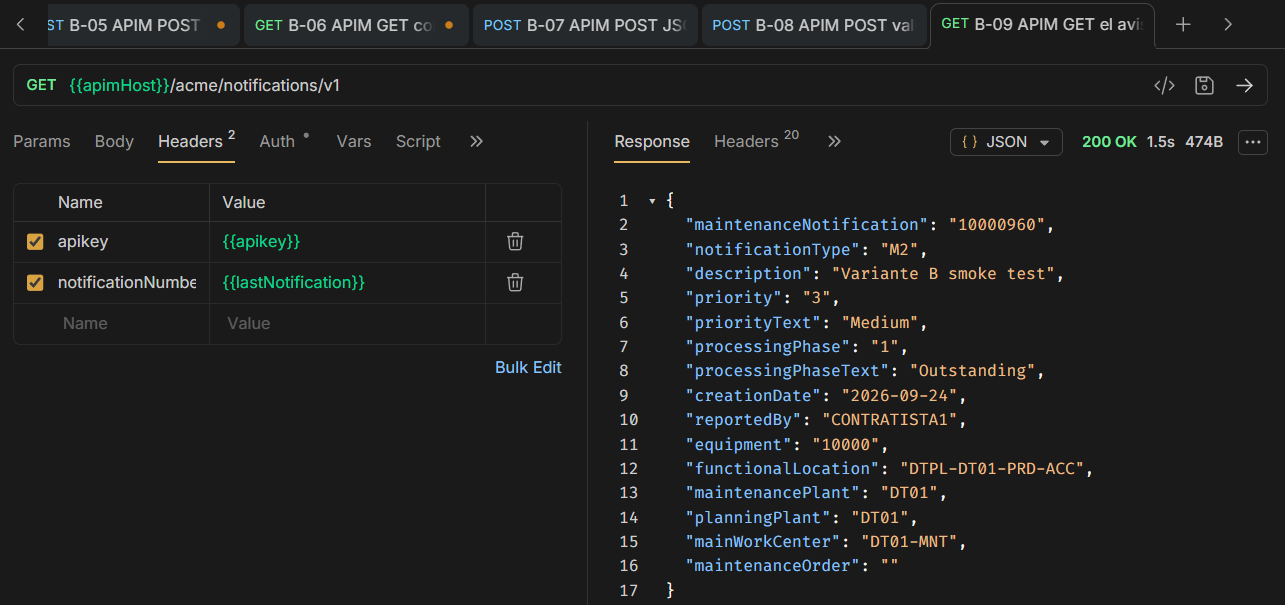 Updated evidence shows priority and its description, processing phase, equipment, functional location, plants and work center.
maintenanceOrder is empty because no order is associated yet. This is a PM business distinction: creating a notification does not automatically create a maintenance order.
Nine laboratory tests
Bruno tests ran through the API proxy with apikey on September 23 and 24. Block 1 does not yet include APIM Fault Rules; the tested CPI errors pass through with their status and body.
| Test | Documented result |
|---|---|
| B-01 · GET existing notification | 200 with flat JSON after XPath correction |
| B-02 · GET valid nonexistent number | 404 NOTIFICATION_NOT_FOUND |
| B-03 · POST priority 9 | 400 INVALID_REQUEST, no SAP call |
| B-04 · POST empty equipment | 400 INVALID_REQUEST |
| B-05 · POST equipment 99999999 | 400 BACKEND_REJECTED |
| B-06 · GET with Cloud Connector stopped | 502 BACKEND_UNAVAILABLE; connector restarted afterward |
| B-07 · POST malformed JSON | 500 INTERNAL_ERROR, accepted behavior for this block |
| B-08 · Valid POST | 201; re-test created notification 10000960 with equipment without leading zeros |
| B-09 · GET newly created notification | 200, same number and flat 15-field JSON |
Notification numbers are historical laboratory evidence. The downloadable part 1 Postman collection checks the earlier contract, including GET XML. Adapt its assertions before using it to validate part 2.
Build lessons and next steps
| Symptom | Applied correction |
|---|---|
| Router condition interpreted as XPath | Configure validation route as Non-XML |
Error End Event becomes INTERNAL_ERROR | Set all three Exchange Properties first so classification recognizes the business error |
| Body reports an error but HTTP is 200 | Use Expression for CamelHttpResponseCode |
| GET concatenates fields into the notification number | Use complete XPath expressions for every response property |
Block 1 is closed according to the updated README and its tests. Block 2 plans Spike Arrest, per-application Quota, removal of apikey before the target and APIM Fault Rules. Block 3 plans externalized parameters and consumer-provided X-Correlation-ID.
The improvement is concrete: the application can distinguish invalid input, a missing notification and connectivity failure, while GET returns usable maintenance-process data.