When Cloud Connector goes down: from a 502 error to a ServiceNow incident
SAP PM case MIX-004: architecture, iFlows, Open Connectors, deduplication and documented tests for alerting Cloud Connector failures in ServiceNow. Includes diagrams and screenshots.
A contractor queries a maintenance notification from an external application. Cloud Connector is disconnected and the API returns 502 BACKEND_UNAVAILABLE. The consumer sees the error, but support receives no alert. SIS-CASE-MIX-004 explores how to turn that technical failure into a ServiceNow incident while preserving the API's error contract.
It follows MIX-003 part 2, whose iFlow creates and queries SAP Plant Maintenance (PM) notifications in S/4HANA. The notification remains the business object; the incident is an operational record about the integration. These are related but separate processes.
Publication scope: ServiceNow and Open Connectors prerequisites have been tested, and a written I-02/I-03 log records incident creation and update. The laboratory README still marks build, complete testing and closure as pending. Final consumer responses and conclusive evidence for I-01 and I-04 through I-08 are missing. Configuration figures and diagrams explain the solution but do not replace those checks.
Download the public case brief, Spanish PDF · Browse all resources
Problem and architecture
The consumer enters through API Management. The MIX-003 parent iFlow handles notification POST or GET and calls S/4HANA through Cloud Connector. If that access fails, its Exception Subprocess classifies the error and calls a child iFlow using ProcessDirect. The child uses the Open Connectors adapter to find, create or update a ServiceNow incident. This alert channel uses Internet access and does not depend on the failed tunnel.
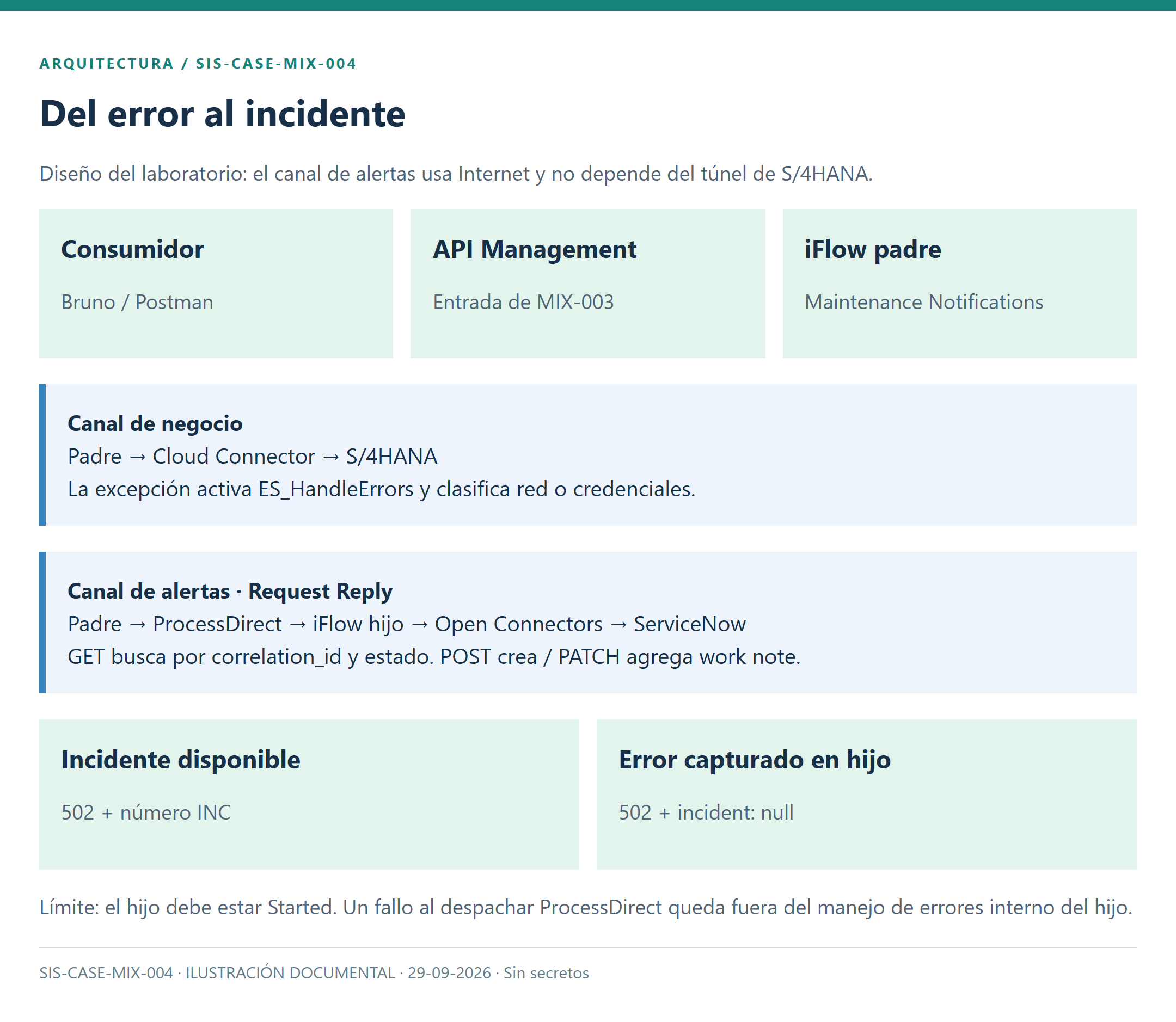 Documentary architecture: the diagram represents the intended flow and its boundaries, not end-to-end test evidence.
The design target is one recurring failure, one open incident: the first request opens a ticket and subsequent requests add work notes. Connectivity failures (BACKEND_UNAVAILABLE, category network) and rejected backend credentials (BACKEND_AUTH_FAILED, category software) require separate routes. This keeps problems with different owners from being sent to the same team.
Checks completed before integrating the iFlows
The ServiceNow PDI was tested for Table API access, incident creation and update, and correlation_id searches. The ServiceNow Open Connectors instance was tested with GET, POST and PATCH. GET /incidents returned a JSON array; POST and PATCH returned JSON objects. In these tests, Open Connectors POST returned 200, while the native Table API returned 201.
A Table API 401 User is not authenticated was resolved in this laboratory by assigning technical-user role snc_basic_auth_api_access alongside incident permissions. Web UI access did not prove API Basic Auth was enabled. Open Connectors credentials belong in Cloud Integration Security Material. Keep Authorization values, User Secret, Organization Secret and Element Token out of the iFlow, screenshots and repository.
| Evidence level | Documented result |
|---|---|
| ServiceNow Table API | GET, POST, state filtering and PATCH tested |
| Open Connectors API Docs | GET, POST, filtered search and PATCH tested |
| I-02/I-03 tests | Written record of INC creation and updating the same ticket with a work note |
| Final consumer response and I-01–I-08 matrix | Complete verification pending |
Child iFlow: find, create or update
The design puts alert logic in Raise_Incident_OpenConnectors_to_ServiceNow. Through ProcessDirect, the parent sends inc_* headers with error code, HTTP method, notification number, exception text and correlation identifier. The child converts this context to properties and prepares a functional key for searching.
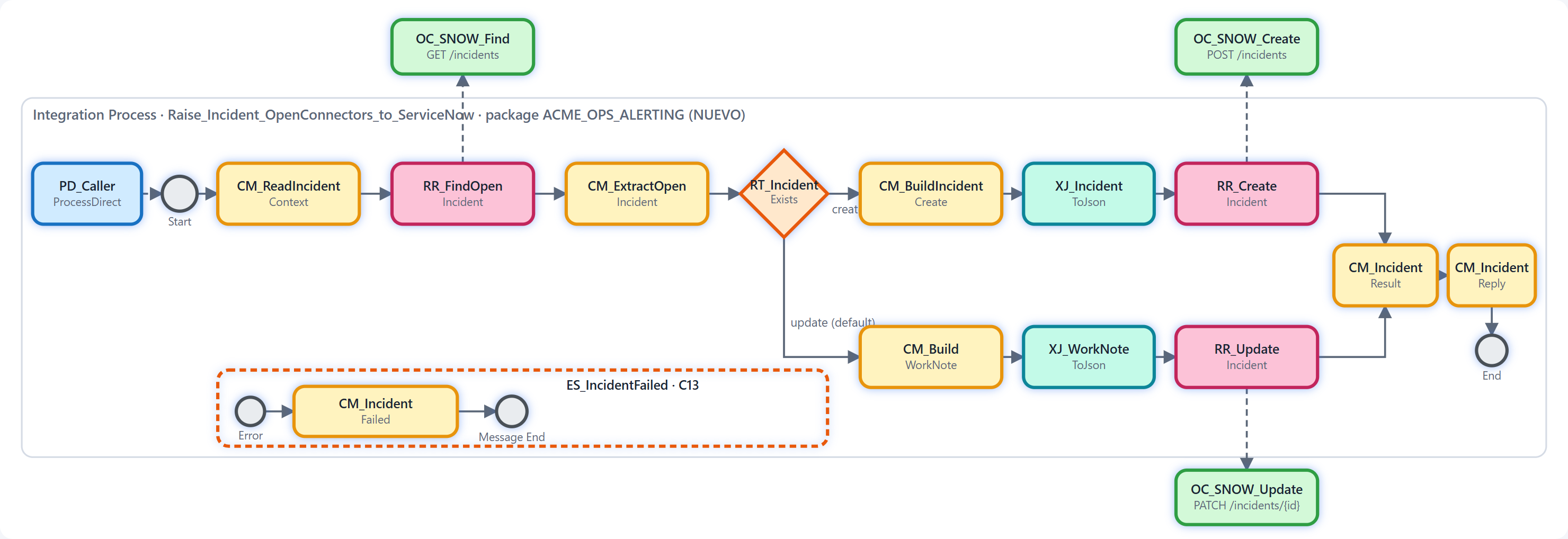 Documentary view extracted from the interactive HTML: find an open incident, choose create/update and handle alert errors locally. Open full size.
The sequence is:
OC_SNOW_Findqueries/incidentsusing the key and open states.RT_IncidentExistschooses between creating withPOSTand updating withPATCH /incidents/{sys_id}. The visibleINC...number does not replace internalsys_idfor PATCH.- A Content Modifier prepares XML and XML-to-JSON conversion creates the connector payload. Exception text requires careful XML insertion: verify character escaping and CDATA termination with adverse inputs.
CM_IncidentResultandCM_IncidentReplyreturn number and status to the parent. The child's Exception Subprocess attempts to returnFAILEDandincident: nullif alerting fails, preserving the original error.
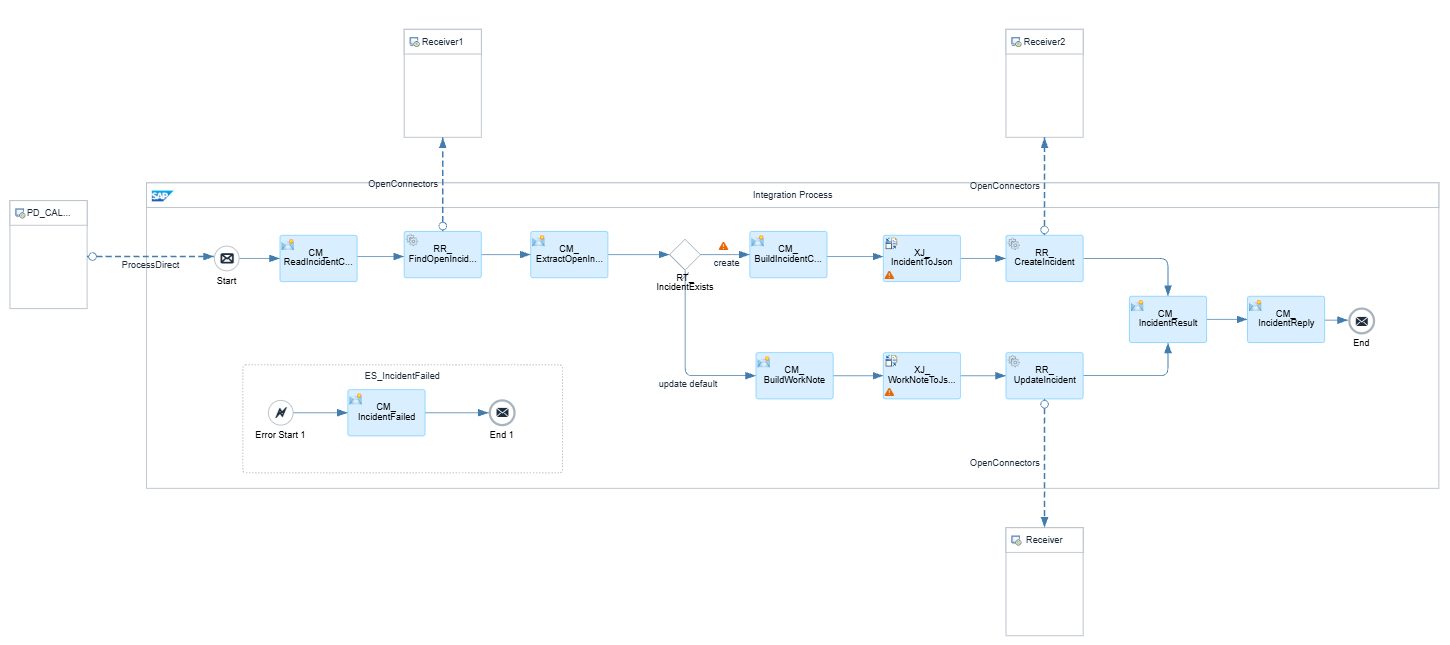 Canvas screenshot from the manual. It shows configured steps but does not prove that every test scenario passed.
Request Reply is a delicate point: the parent needs the incident number before building its response. If the child is not started, ProcessDirect may fail while the parent is already inside its Exception Subprocess. The child therefore includes local error handling, and the pending matrix must explicitly test alert-channel failure. We cannot promise every exception will preserve 502 until that test is complete.
Parent iFlow: preserve the original error
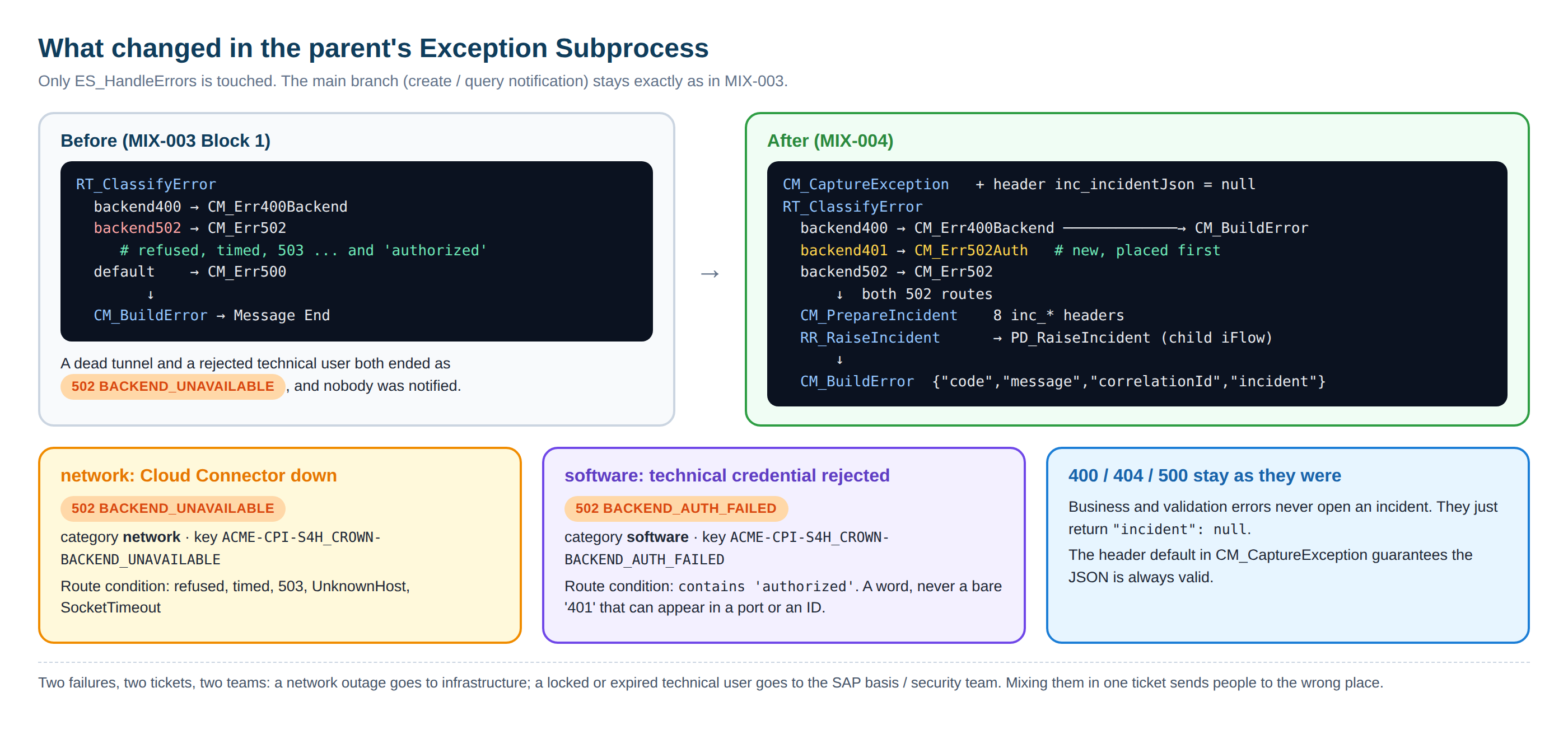
The MIX-003 main process retains notification creation and query branches. Proposed changes focus on ES_HandleErrors: capture the exception, distinguish credential rejection from connectivity failure, prepare inc_* headers, call the child and add incident to the error JSON.
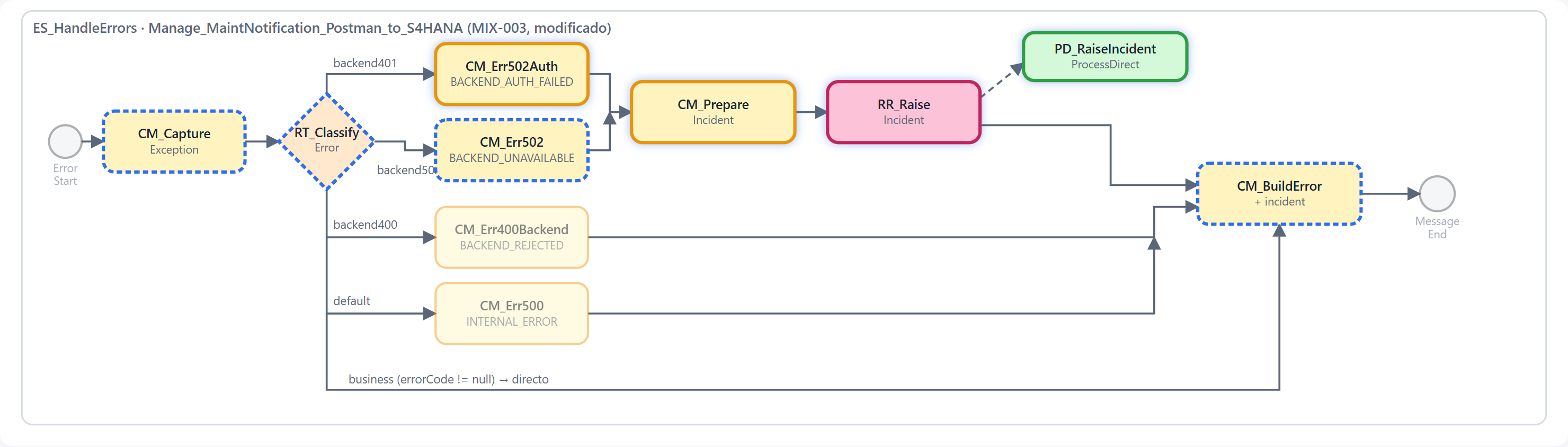 Documentary error-handling view: 400 and 500 routes remain separate from the two 502 routes that request an alert. Open full size.
 English manual diagram:
 network represents connectivity and software rejected technical credentials. Open full size.
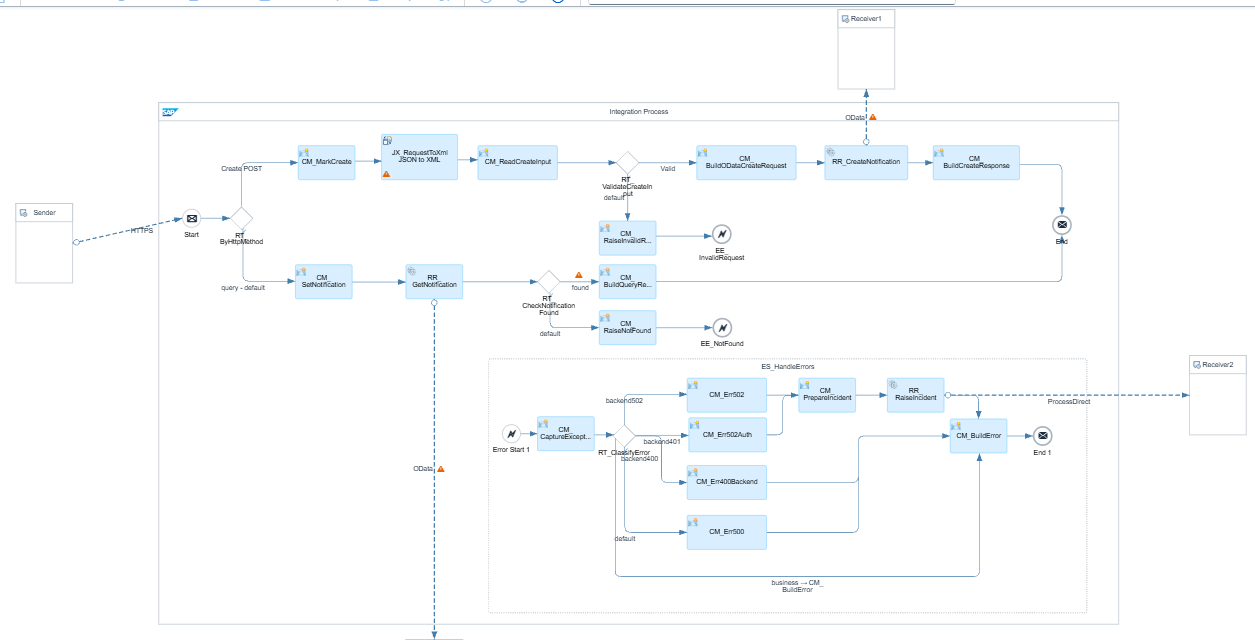 Parent configuration screenshot; the final consumer response still requires test evidence.
The intended response preserves code, message and correlationId, adding incident. The original example message means S/4HANA could not be reached:
{
  "code": "BACKEND_UNAVAILABLE",
  "message": "No fue posible llegar a S/4HANA",
  "correlationId": "MPL-ID",
  "incident": "INC..."
}
This JSON is illustrative, not a captured response. If ServiceNow also fails, the design aims to retain 502 with "incident": null. correlationId identifies the Cloud Integration message for MPL lookup. ServiceNow's correlation_id deduplication key is different: it represents the failure type and stays stable across requests.
Deduplication: use key and state
The child searches for the same functional key only among New, In Progress or On Hold incidents (state IN (1,2,3)). A match receives work_notes; otherwise a new ticket is created. In the tested PDI, a Resolved incident still had active=true. Filtering only by active would have reused a ticket already considered resolved.
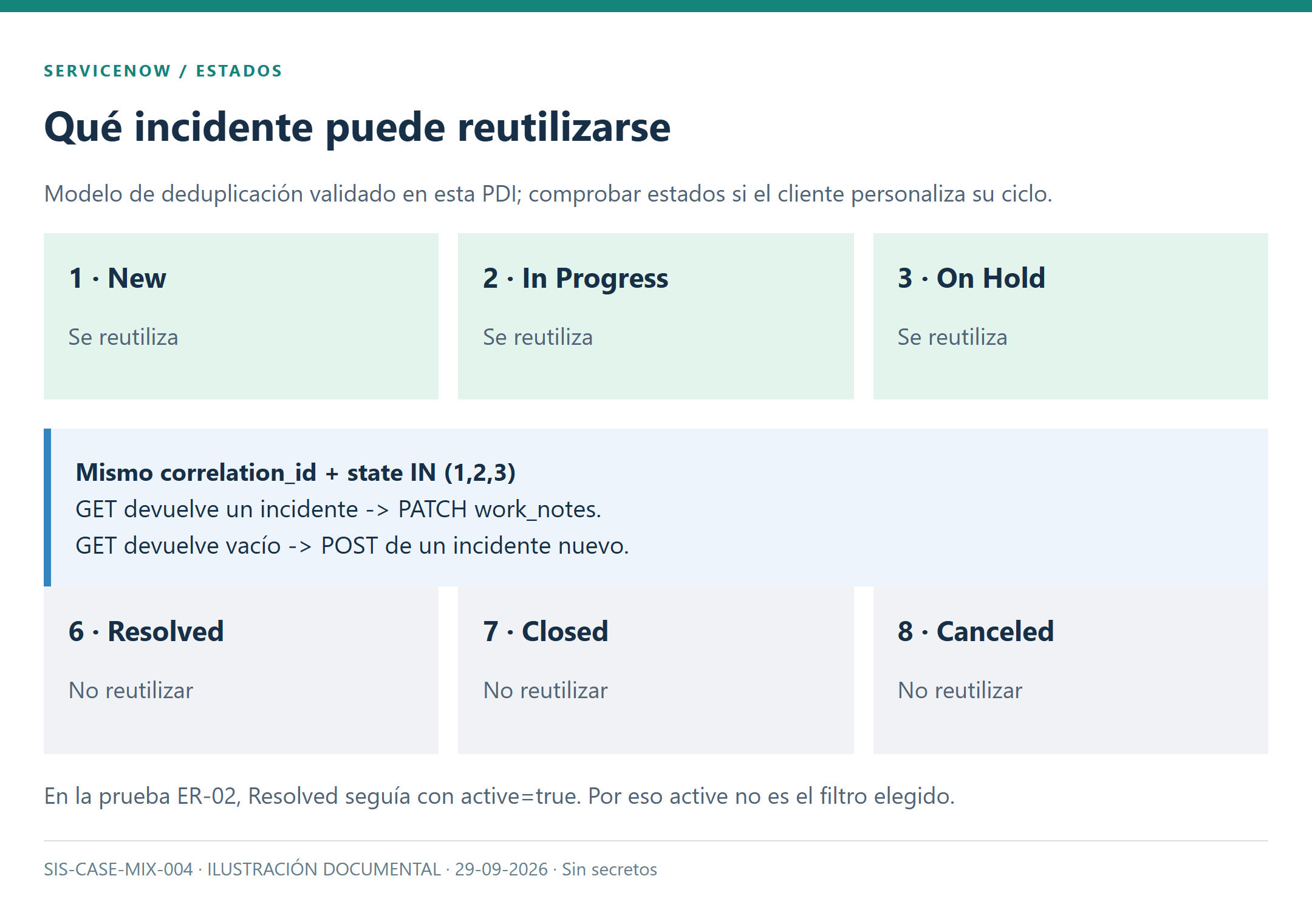 Rule observed in this PDI. Review the filter for an instance with custom states.
The adapter query needed another adjustment: a where expression typed directly into configuration caused an endpoint problem. A pre-encoded version combined with fields and pageSize caused an expression error. The guide documents the successful option: generate unencoded where in a property, reference that property in the receiver and set Page Size = 1 in its dedicated field.
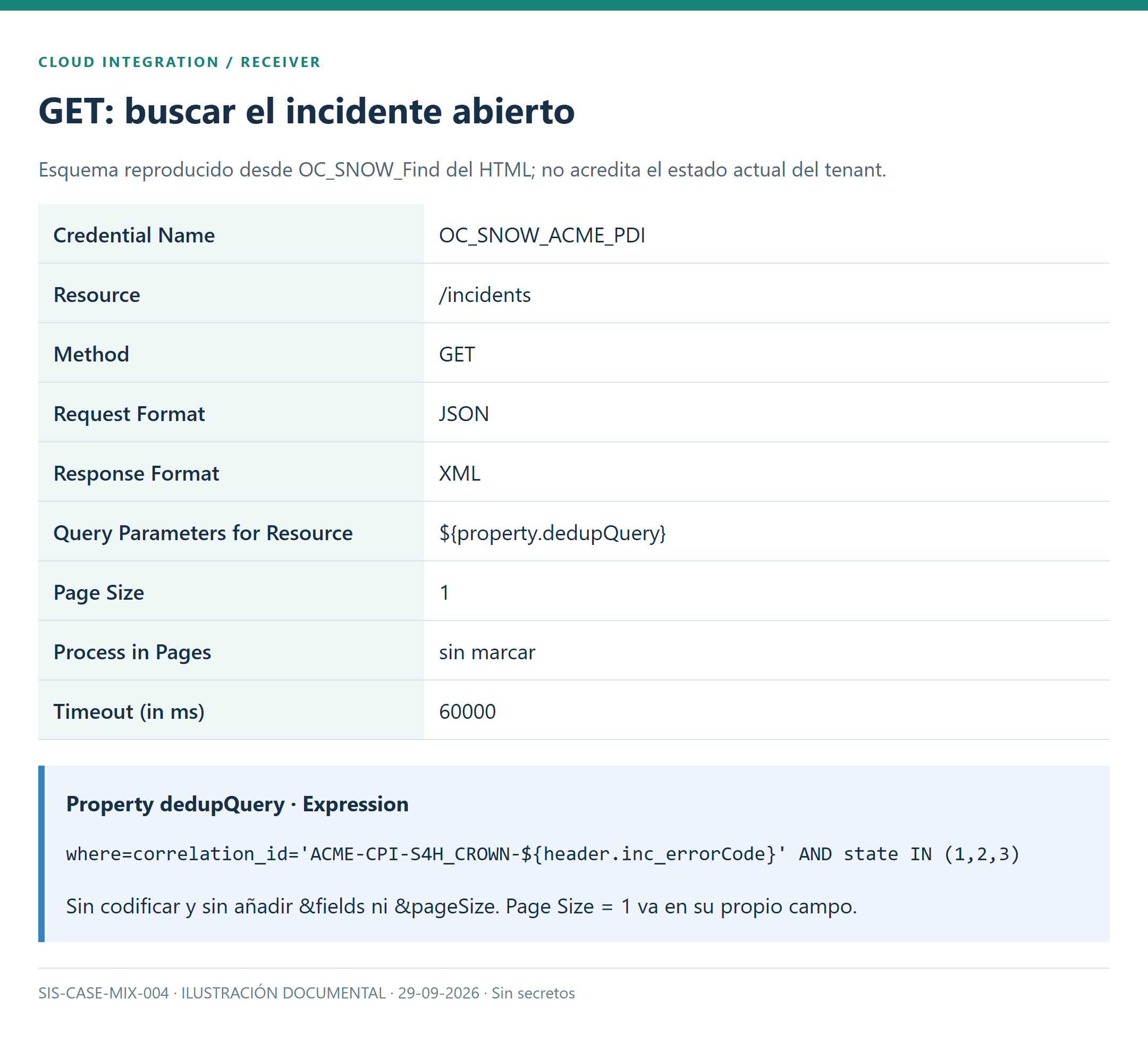 Receiver diagram based on the HTML guide. It contains no secrets and does not establish the tenant's current status.
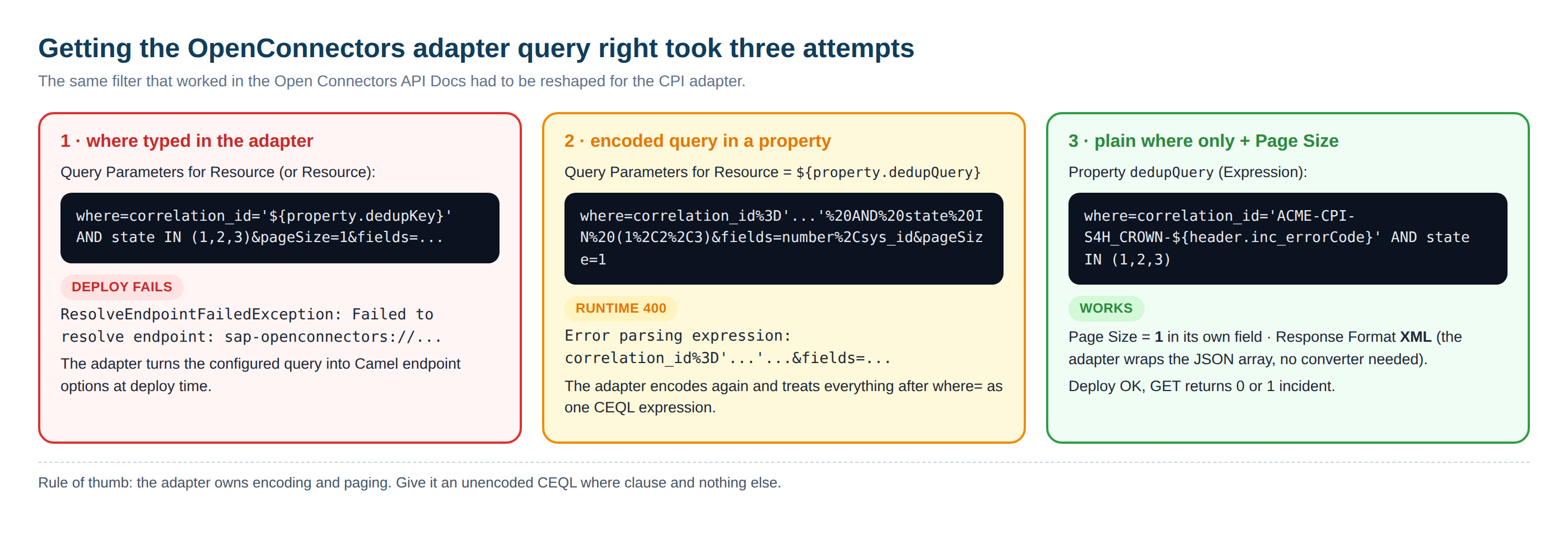 Manual comparison: the adapter handles encoding and pagination; the property supplies only the
 where expression. Open full size.
Searching and then issuing POST is not atomic. Concurrent messages could both find no incident and create duplicates. Avoid blind POST retries after timeout: query ServiceNow first. Concurrency and retry decisions remain open for operational use.
Recorded results and remaining tests
The written I-02/I-03 log describes an incident created during a Cloud Connector failure and a second request adding a note to that same ticket. The English manual shows the flow and an incident screenshot, but the documentary review notes that the final consumer response containing the same INC and correlationId was not attached. We therefore report the recorded creation/deduplication without claiming the complete matrix passed.
| Test | Required demonstration | Documentary status |
|---|---|---|
| I-01 | Connected Cloud Connector: query returns 200, no incident | Conclusive evidence pending |
| I-02 / I-03 | Disconnected connector: create INC, reuse it with a work note | Written record; consumer evidence still needs closure |
| I-04 | Resolve INC and repeat: create a different ticket | Pending |
| I-05 | ServiceNow or child failure: preserve 502 with incident: null | Pending |
| I-06 / I-07 | 400/404 without alerts, and POST with connector disconnected | Pending |
| I-08 | Rejected SAP credential: BACKEND_AUTH_FAILED and separate incident | Pending |
Closure requires verified deployment of both iFlows, Bruno or Postman responses, correlated MPLs, ServiceNow work-note history and checks for timeouts, concurrency and special characters. Until that evidence is complete, MIX-004 remains a documented implementation in progress.
The public two-page brief, in Spanish summarizes the architecture and limitations without exposing credentials or tenant identifiers.